
Outstanding Warrants in Maryland
In Maryland, an "outstanding" warrant is simply one that has not been reported as served or resolved. The state offers no public status field confirming every such record. The Judiciary's public Case Search is a docket index, not a complete active-warrant register, and restricted systems like METERS and the FBI's NCIC are not search tools for residents. A 2018 Montgomery County Police directive describes one piece of the machinery: an agency query of District Court warrants through the Maryland State Warrant System on the day of issuance. That document names no current platform owner, lists no participating agencies, defines no statewide coverage, and offers no public access. Maryland State Police CED/MSAT coordinates fugitive apprehension with partner agencies, but its official page describes a program rather than a public self-search. If you suspect a warrant, start with the likely filing court and use Browse Counties to find the court and sheriff route for that area. The docket points the way; only the issuing court and its assigned service agency can confirm the current record.
Maryland Has No Complete Public Active-Warrant Search
No single active-warrant search covers Maryland. Case Search shows eligible docket information, some county sheriff pages publish selected local entries, and operational databases stay restricted to authorized users. The DPSCS Criminal Justice Information System Central Repository receives criminal-history events, but it is not an open warrant-status service. The right route depends on your question. Use the options here to locate a case or reach the office that can answer it, and treat no public result as a statewide clearance.
| Route | What it can help locate | What it does not establish |
|---|---|---|
| Judiciary Case Search | Eligible public case docket and likely court. | Every active warrant or a guaranteed current service status. |
| County sheriff list | Entries selected for publication by that local office. | All warrants in Maryland or even every warrant in that county. |
| State Warrant System / METERS / NCIC | Authorized agency queries for operational purposes. | A resident-accessible search; public coverage and fields are not documented. |
| MSP CED/MSAT | Statewide interagency fugitive-apprehension support. | A public roster or personal status lookup. |
The Maryland Active-Warrant Picture
A Maryland warrant begins with a court order. A local sheriff or another assigned agency may serve it, while court staff keep the docket and handle later motions, appearance records, or recall orders. Reports may flow into criminal-history systems under state rules, but that movement never makes every record visible in one public portal. Local practice varies too. Some sheriff offices post a public list. Others offer only a contact or tip line, and still others send questions back to the filing court. No few local pages add up to a statewide picture of active warrants. Confirm the venue and serving agency with the court tied to the case.
Note: A court event, a local web list, and an operational warrant query can change on different schedules, so check the issuing court for current status.
How Maryland County Warrant Lists Set Their Scope
Scope is a local choice in Maryland. The Anne Arundel County Sheriff says its online active-warrant list covers unserved county warrants active for at least six months and is refreshed weekly, while stating plainly that it is not a list of all outstanding warrants. The official page notes that entries reflect the upload date and that law enforcement must verify a warrant before acting on it. An entry served recently can stay visible until a later weekly upload. The six-month threshold is just a publishing choice; a warrant does not expire at six months.
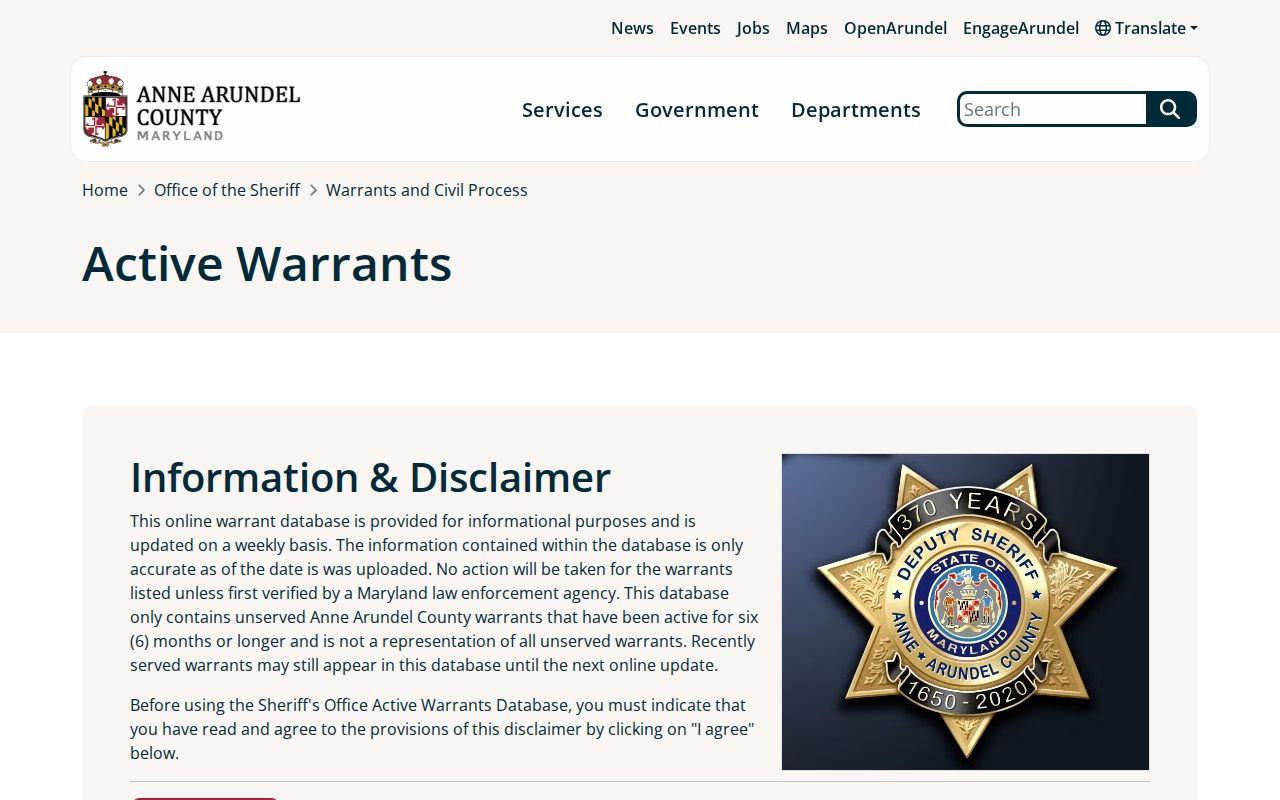
The reference image shows the list context and disclaimer rather than an individual entry; the live county page controls its current scope and contents.
The Prince George’s County Sheriff offers a different county-only page with a “Type to Search” label and “Search...” input above dated post cards. The accessible page does not state that the posts include every warrant or promise a refresh schedule. Its “Submit A Tip” control is for information to the Sheriff, not a way to check or resolve the user’s own case. Neither local interface should be read as a statewide database.
Where a sheriff list exists, read the scope notice and date before drawing a conclusion. The local court remains the authority for the case and can identify the serving agency. Official local examples include the Anne Arundel active-warrants page and the Prince George’s County Sheriff database. Note: An Anne Arundel list entry may remain after service until its next scheduled weekly upload.
Active Warrants: What They Show
Maryland Case Search can display a case number, party name, date of birth, party type, court, case type, status, filing date, or caption, and sometimes charges, trial dates, and disposition. The exact public docket fields vary. These are case-index details, not a fixed active-warrant record, and a case status does not reveal whether service is still pending. For Anne Arundel, the published labels describe only the list and tip-data area of the page. Treat them as a schema, not as confirmed search filters or a statewide record format. The issuing court remains the place to verify whether an active warrant exists.
| Name | Field label seen on the local page; individual warrant entries were not retained. |
|---|---|
| Warrant No. | Published label; no statewide number format was verified. |
| Age and Charge | Labels in the accessible list/tip area, not guaranteed fields for every county. |
| Last Known Address, City, ZIP | Labels recorded from the local page; do not treat these as required search inputs. |
| Current service status | No fixed public statewide field was confirmed; ask the issuing court or assigned agency. |
Maryland's MSAT Is Not an Active-Warrant Search
The Maryland State Police Criminal Enforcement Division includes the Maryland State Apprehension Team, known as MSAT. Its job is hands-on. The team tracks down wanted fugitives with local, state, and federal partners. What it does not run is a public search. The MSP CED/MSAT page offers no statewide roster, no name-search form, and no warrant-status service. That matters for anyone hunting an active warrant. Maryland courts issue and recall their own orders, and the assigned agency handles service. MSAT changes none of that. If you need to confirm your own case, call the filing court rather than filing a tip about yourself through a fugitive interface. Maryland's other systems sit behind the same wall. METERS, NCIC, and the criminal-history repository are law-enforcement tools, not public warrant lookup channels. So a cooperative fugitive program tells you nothing about one person's warrant records. It publishes no complete list and no update schedule for a private matter. Ask the clerk which office holds the next step in your case.
Maryland Warrant Roundups
Maryland State Police CED/MSAT is an interagency apprehension resource, not a recurring statewide roundup list. Individual operations may report arrests or cleared warrants. Those numbers measure one operation's work. They are not a current Maryland warrant count, and Maryland publishes no comprehensive statewide public most-wanted roster. Where an agency posts a most-wanted appeal, treat it as what it is: a selected set of cases seeking public help. It is not an active-warrant search. Use the agency's own current page for any appeal, and leave the names and images where they sit. Copying a roster into a separate index helps nobody. See State Most Wanted for the program and tip-route distinction. For a personal status question, the court and sheriff route still governs the case. Roundup coverage tends to be regional, operation-specific, or tied to particular investigations. It never replaces an individual docket inquiry into one outstanding warrant.
Maryland Warrant Operation Counts Are Not Statewide Totals
The U.S. Marshals Service reported that Operation Baltimore Safeguard, run January 20 through 31, 2026, produced 239 arrests and 264 warrants cleared. Those are impressive figures. They also describe a single dated operation by participating agencies. They do not count every Maryland warrant, show how many remain open, or offer a live statewide status feed. Aggregate releases like this one do show how state, local, and federal teams coordinate, and that coordination is real. Just do not convert the totals into a claim about all Maryland warrants. The official U.S. Marshals release reports the operation's results and nothing more; it is not a public warrant-search endpoint. For an individual Maryland matter, use the public docket to find the likely venue, then contact the clerk or service agency. An operation total has no bearing on whether a particular court has recalled or served a warrant. Note: These figures are operation results, not current balance figures for Maryland courts or sheriffs.
Finding Your Own Name on a List
Found what looks like your name, or a family member's, on a Maryland local page? Pause before trusting the entry. Names can match by coincidence. Publication can lag behind actual service. A local page can also omit warrants on purpose. Match a positive result to the court case, then confirm with the issuing court or sheriff. A no-hit proves little either way; it does not establish that the court recalled a warrant. Take the name, case number, and county or city from the public record and ask a focused question. Maryland Judiciary Case Search can locate the public docket, and its FAQ explains the search limits, including the first-600 result cap and the chance of a "no electronic record" message. If the docket is not online, contact the court through the county directory.
- Identify the filing court from a notice, citation, or public docket; do not assume it is in your current county.
- Call the District Court clerk for a District Court case or the Circuit Court clerk for a Circuit Court case, and ask about current warrant status.
- Ask which sheriff or other assigned agency can confirm service or surrender arrangements.
- If the court has issued a recall or other order, request the written confirmation and ask whether the serving agency has received it.
- For a separate MVA notice, contact the agency named there and confirm the MVA status independently from the court case.
Important: Do not rely on a local list alone. Confirm the record with the Maryland court that issued it and the agency assigned to serve it.
Maryland Active-Warrant Results Have Access Limits
Maryland does not treat every warrant paper as public. Arrest-warrant records and charging documents stay closed until service and return, or until 90 days pass, under General Provisions §4-316 and Maryland Rule 4-212, with some exceptions. Juvenile delinquency records are confidential. Case Search can display an eligible docket yet hold back a related paper, or show no electronic record at all, so a blank screen settles nothing. Courts and sheriffs also publish on their own schedules. Ask the clerk what is legally available and whether a formal record request fits your situation. For permitted District Court records, the Judiciary offers the judicial-record access route; a request to a local law-enforcement agency follows that agency's rules and cannot force the release of exempt information. A District Court case file can be requested through the local clerk under Maryland Rules Title 16, using form DC-034 for one case and DC-034A for multiple cases. The MPIA covers eligible executive-agency records, not court files and not instant warrant status. A federal matter goes through PACER and the U.S. District Court for Maryland clerk; RECAP may supply docket copies where available, but it is not an official warrant-status source. An MVA notice travels its own statutory route, so verify the warrant with its issuing court and the notice with MVA or the named agency.
Because of these Maryland limits, an active-warrant search cannot end at a name match. Confirm directly with the court handling the case. Note: A court order and an agency confirmation document separate steps in the Maryland case process.