
Maryland Warrant Searches
Maryland offers no public statewide warrant lookup anyone can open. Your best first stop is Maryland Judiciary Case Search, the docket portal for the state's courts. It can point you to a case and the court that filed it. It cannot certify that a warrant is active. A 2018 Montgomery County Police directive describes officers querying District Court warrants through the Maryland State Warrant System on the day they issue. That is an agency tool, not a resident portal, and it promises nothing about current platforms, universal participation, or full coverage. Use these steps only for a matter tied to you or a family member. Write down the case number and court name. Then ask the clerk which office can confirm the present warrant and its service status.
- Search Case Search by last name, adding a first name when known. Use the Judiciary FAQ for the published name-search limits and narrow the docket results carefully.
- Record the case number, court, case type, and any relevant date. Do not treat a docket event or an empty result as a warrant decision.
- Open Browse Counties to reach the county or Baltimore City route for the filing court and local sheriff. Maryland has 23 counties and Baltimore City as a separate court jurisdiction.
- Contact the District Court clerk for a District Court case, or the Clerk of the Circuit Court for a Circuit Court case. Ask whether the court can confirm current status and which sheriff or other assigned agency handles service.
- If Case Search does not locate the matter, ask likely filing courts about their records process. For an agency record, use the agency’s Maryland Public Information Act process; for federal court matters, use PACER and the U.S. District Court clerk.
Maryland Case Search Locates Dockets, Not Warrants
The Maryland Judiciary's Case Search FAQ explains how to pull public case information. It covers eligible docket records in one searchable view. On March 14, 2026, the Judiciary launched a redesigned Case Search and Record Search portal, per its official launch announcement. The redesign did not turn Maryland Case Search into a warrant-status register. The FAQ page spells out the Judiciary's own search guidance.
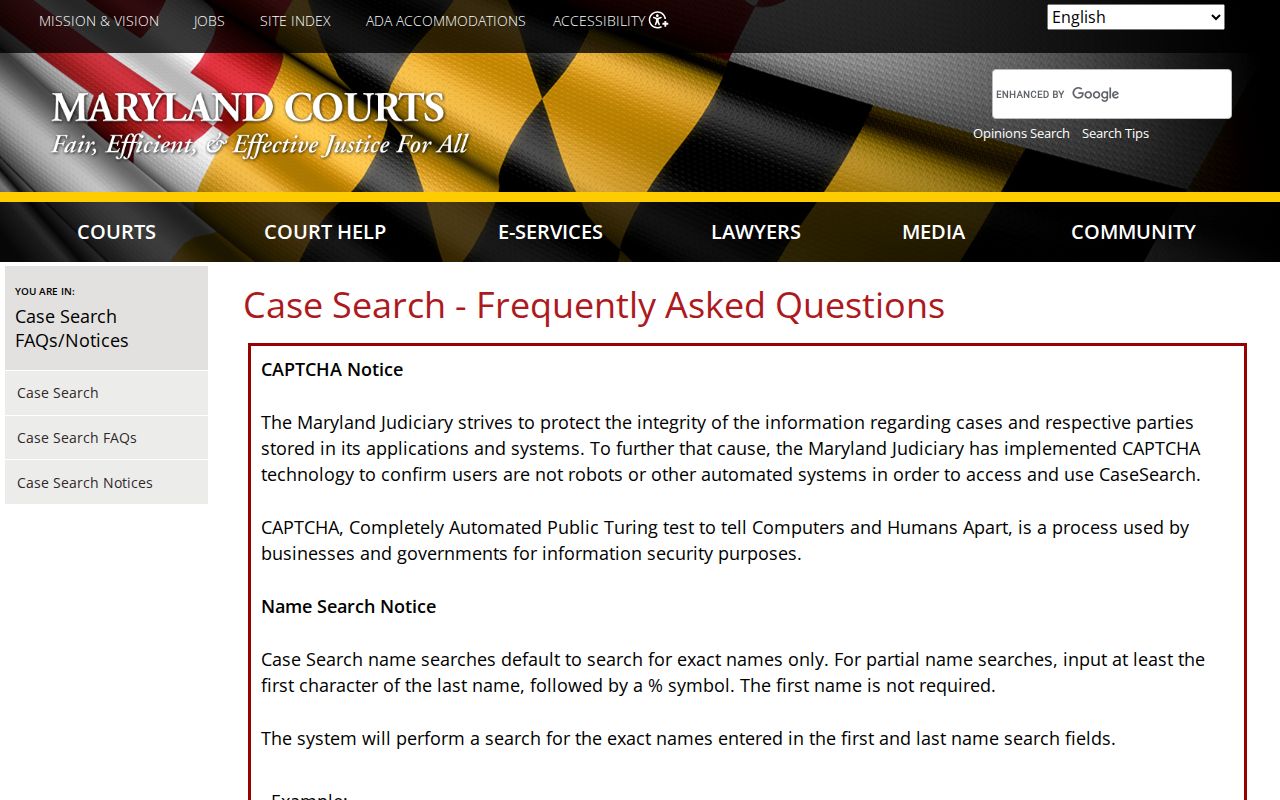
Coverage in the public docket runs wide but not deep. Maryland's District Court traffic, criminal, and civil matters appear, along with Circuit Court criminal and civil records. Other categories follow their own access rules. A docket hit can tell you which Maryland court and case to ask about. It does not promise an active-warrant field, service history, or a complete set of warrant papers. Nothing online settles warrant status. Some record types never appear electronically. Courts and dates can drop out too. The FAQ describes the search behavior the Judiciary publishes. The redesigned portal's full controls may differ from older instructions. So trust the live Maryland page over any assumed button, filter, or field. Use both together. Note: Confirm current Case Search controls on the live Maryland Judiciary page before following older instructions.
What a Maryland Warrant Search Asks For
The public Case Search FAQ describes a name search plus several ways to narrow results. Those are documented search rules, not labeled controls you will certainly meet in the redesigned interface. Date of birth can appear in results. Do not treat it as a required Maryland search input.
| Documented item | Type | Required or limit | What the FAQ supports |
|---|---|---|---|
| Last name | Name criterion | Required to begin | A last name is needed for a name search. |
| First name | Name criterion | Optional | May be added to narrow a name search. |
| First character plus % | Partial-surname pattern | Limited use | The FAQ describes this pattern for a surname; it does not describe a wildcard at the start or middle. |
| Court, case type, date range | Result-narrowing criteria | Optional narrowing | Published guidance says these criteria can help reduce a result set. |
| CAPTCHA | Human-verification step | May appear | A challenge may interrupt an online search. |
| First 600 results | Result ceiling | Maximum returned | Only the first 600 matches are returned; add criteria rather than treating them as exhaustive. |
Maryland's public search exists to find docket records. It takes no verified warrant number, date of birth, or law-enforcement status query. No such public controls exist in the state.
Maryland's 600-Result Warrant Search Limit
A broad Maryland name search can overflow the display. The Maryland Judiciary FAQ caps the display at the first 600 records returned. Refine instead. Narrow by court, case type, or date. A capped list is not a full name history. It cannot prove no other Maryland case exists, so check each plausible court. The percent sign has one published use. Pair the first character of a surname with "%" to pull names beginning with that character. The FAQ does not describe putting the mark at the start or inside a surname. A misspelling, a changed name, or a misplaced wildcard can steer you away from the right docket. Maryland records also vary by court, category, and date. When criteria feel shaky, ask a clerk how to locate the case rather than repeatedly changing portal controls.
Maryland Warrant Search Results
A Case Search result is docket information, nothing more. Depending on the record and access rules, it may carry a case number, party name, date of birth, party type, court, case type, case status, filing date, or caption. Charge, trial date, and disposition may appear too. Maryland publishes no fixed active-warrant schema through this portal. So case information alone is not confirmation of a warrant's current status. A warrant paper may sit restricted or missing from the online docket. Result columns can vary too. Treat any Maryland docket hit as a lead. Let the court or agency confirm the warrant facts that matter.
| Public case number | Identifies a docket for a clerk handoff; it is not a warrant number unless the court separately says so. |
|---|---|
| Party name and date of birth | May help identify the public case; do not assume the data uniquely identifies a warrant subject. |
| Court, case type, status, filing date, caption | Can show the docket’s venue and case context, subject to the record’s access and coverage limits. |
| Charge, trial date, disposition | May be displayed as case details, but does not itself report whether a warrant remains active. |
| Warrant number, service agency, current status | No fixed statewide public set of these fields was verified. Ask the issuing court or assigned agency. |
Note: Keep the case number and filing-court name together when you call the clerk, because those details identify the docket far better than a saved image alone.
When Maryland Warrant Search Says No Electronic Record
A “no electronic record” result is not a clearance. The search may have missed the name, or a date criterion was entered wrong. Some Maryland records are simply not public or not online. A Maryland warrant can exist without a public result. A docket can also stay online after a warrant’s status changes, so treat the portal as a first look rather than a final answer. Try the likely court or case type too. If you hold a citation, notice, or another case clue, contact the filing court directly. No court known? Use the county directory to reach local Maryland District Court and Circuit Court offices, then ask the clerk what details would pinpoint the docket and whether the court can confirm the current order.
Key point: A portal no-hit and a local-list no-hit are both inconclusive. Only the court or assigned law-enforcement agency can confirm its current record and service status.
Maryland Warrants: Who Holds What
Every Maryland warrant lives in two hands. The issuing court keeps the judicial case record, while an assigned sheriff, police agency, or other authorized agency handles service and its operational status. A 2018 Montgomery County Police directive describes the Maryland State Warrant System as a District Court warrant query available to agencies. It is not a public lookup. No resident query option is published, and METERS, NCIC, and DPSCS Criminal Justice Information System services are restricted besides. Local publication varies. The Anne Arundel County Sheriff’s active-warrants page describes a local subset and its update limits. The Prince George’s County Sheriff database is another county-only route. Neither is a statewide index. Use Browse Counties to find the local Maryland court and sheriff for the place tied to the case. The court structure narrows the hunt. Maryland has no separate municipal or justice-of-the-peace criminal trial-court tier for routine traffic and misdemeanor warrant matters. The District Court, organized statewide into 12 districts, handles most traffic and misdemeanor cases. Circuit Courts in each Maryland county and Baltimore City handle felony and general-jurisdiction matters. The Judiciary court directory routes a person to the appropriate local clerk.
Maryland Warrant Records: Court Requests and MPIA
Maryland court records follow Maryland Rules Title 16 and the Judiciary’s judicial-record access process. For a District Court file, the current DC-034 form requests inspection or copies for one case. DC-034A covers multiple cases. An online warrant search is not the channel. Requests go in person or by mail to the court. The current form lists copy charges of $0.50 per page and $5 for a certified document. Restrictions still apply. The Maryland Public Information Act, or MPIA, works differently. It reaches releasable executive-agency records, not a substitute for the court clerk’s judicial-record process. An MPIA request to a Maryland sheriff or police agency may seek agency records under the custodian’s rules and exemptions. It is not a real-time warrant check. It never forces release of restricted information either. The Attorney General’s MPIA guidance explains the agency-request route. Ask the filing clerk about Title 16 first. Give the case number and court when you have them. Note: Court files follow Title 16, while MPIA requests reach eligible agency records and never certify current warrant status.
Which Maryland Warrants Stay Restricted
Maryland law limits public access to specified arrest-warrant records and related charging documents. General Provisions §4-316 and Maryland Rule 4-212 generally keep that court material restricted until the warrant is served and the return filed, or until 90 days pass. Exceptions and court orders can change the timing. The rule covers specified arrest-warrant material only, not a single access period for every warrant document. Juvenile records sit apart. Juvenile delinquency records stay confidential under Maryland law, with limited exceptions. Case Search does not bypass those protections. A portal result may omit restricted papers even when a related case is visible.
Access rule: A missing public document may reflect a legal restriction, not a missing court action. Ask the local clerk what record access the law permits.
Restrictions on arrest warrants and charging documents come straight from Maryland General Provisions §4-316 and the Maryland criminal procedure rules. For any Maryland case, ask the filing court.
Maryland Warrant Checks for Federal Dockets and MVA Notices
A federal matter will not show up in a Maryland state docket search. Use PACER for federal docket access. Contact the U.S. District Court for the District of Maryland clerk about its case. Public federal dockets can omit sealed or restricted entries. They are not a complete public warrant finder. RECAP copies may supplement PACER where available, but they do not certify a warrant’s current status. A Maryland MVA notice is another distinct route. Maryland Transportation law allows certain driving-privilege or vehicle-registration actions after a law-enforcement report of an outstanding warrant under §16-204. That notice concerns MVA status, not the warrant itself. Follow the issuing agency named in the notice. Confirm any underlying case with the court, and ask separately whether the MVA has received the court’s clearance notice. So a Maryland warrant check can take more than one official contact. A public docket search, a court clerk, and the serving agency each answer different questions. Keep the case number, and any written court order, for later status checks.