
How Maryland Warrants Are Tracked
Maryland runs one statewide District Court, split into 12 geographic districts. Circuit Courts sit alongside it. They serve the 23 counties and Baltimore City through eight judicial circuits. Most traffic and misdemeanor matters land in District Court. Felony cases go to the Circuit Court, the general-jurisdiction trial bench. No separate municipal or justice-of-the-peace criminal tier handles routine city warrant cases. The issuing court keeps its case record with the clerk. A sheriff or another authorized agency may execute the order and report service. State and federal databases help authorized operations behind the scenes. Either way, a warrant check comes down to the issuing court and its local service route, not a system name.
Basic path: District or Circuit Court issues a warrant › local clerk holds the case file › an assigned law-enforcement agency handles service › the return or recall is recorded through the relevant court and agency process.
Maryland State Warrant Query Has Limits
One document anchors the state-level story. A 2018 Montgomery County Police Warrant Control Unit directive says agencies could query District Court warrants through the Maryland State Warrant System on the day of issuance. That is the clearest named state warrant query anywhere in public view. It is local police policy, nothing more. It covers agency access only. No public search page comes from it. The policy never says who owns or runs the Maryland system today, which agencies participate, or how served and recalled statuses get refreshed. Whether every District Court warrant type appears is unstated. Circuit Court process may or may not be included. Nothing proves each Maryland warrant lands in a statewide index. Treat it as a restricted District Court query documented in one 2018 policy. Note: the directive supports a limited agency-query claim, not a resident's search of a complete Maryland warrant database.
The Maryland Warrant Database
Several channels get mistaken for one Maryland warrant database. Maryland Judiciary Case Search is a public case index. The Maryland State Warrant System is the restricted agency query described in the Montgomery County policy. METERS, NCIC, E*Justice, and LInX appear in operational law-enforcement material. DPSCS CJIS is a criminal-history repository. Each has its own access rules and purpose. No public source lists full participation or a warrant-type inventory for the restricted systems. Then the record portal changed. The Maryland Judiciary Case Search & Record Portal launched March 14, 2026, folding public Case Search and Judiciary Record Search into one interface. The official launch announcement shows the new portal and its stated docket scope, not any new warrant coverage.
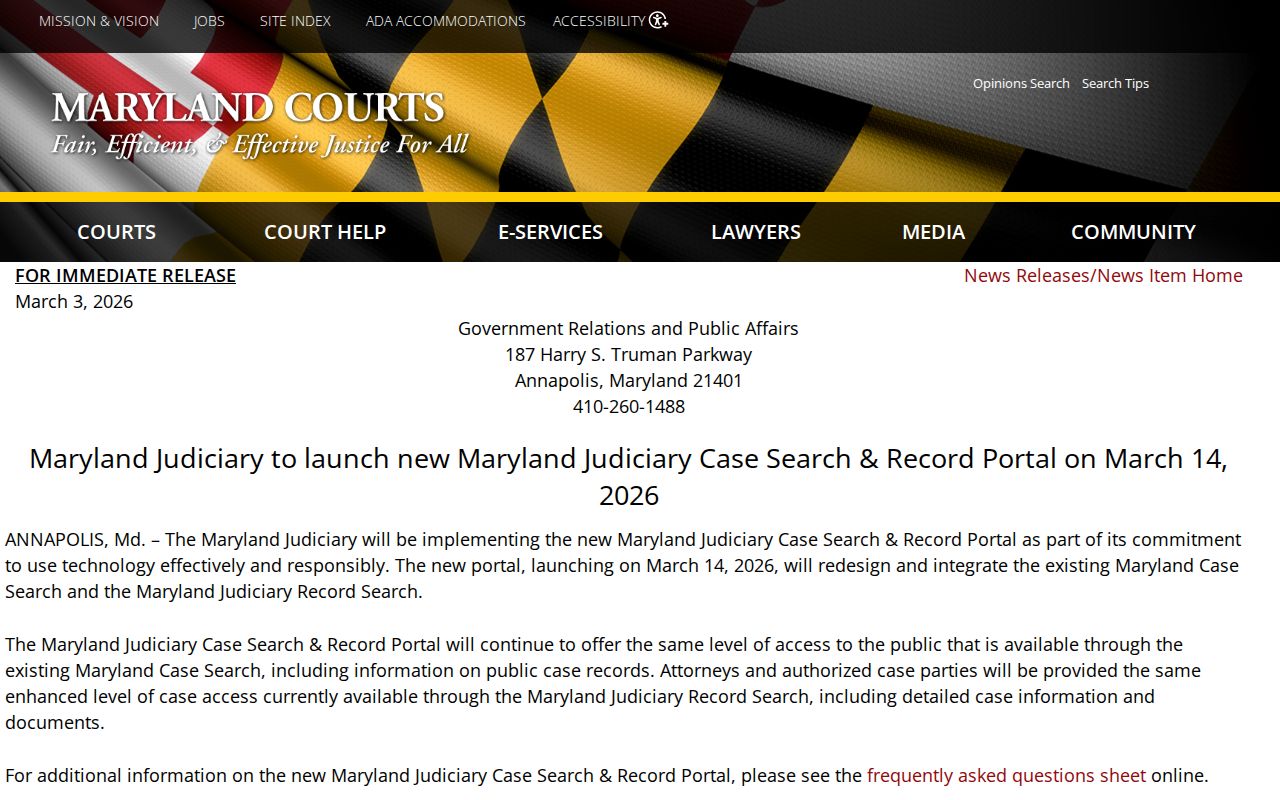
The launch notice marks a court-record access milestone for Maryland. It is not a new active-warrant register.
| System | Verified Coverage | Operator or Run By |
|---|---|---|
| Maryland Judiciary Case Search & Record Portal | Selected public court-case and docket information; not complete warrant status. | Maryland Judiciary. |
| Maryland State Warrant System | District Court warrant query on issue day documented in a 2018 local directive; wider scope unknown. | Current operator not identified in reviewed public sources. |
| METERS, NCIC, E*Justice, LInX | Restricted operational systems; public coverage and participation details are not published. | Authorized law-enforcement use; complete operator matrix not established here. |
| DPSCS CJIS Central Repository | Criminal-history record services and statutory event reporting. | Department of Public Safety and Correctional Services. |
Maryland Warrant Checks Start With Case Search
Case Search is the practical starting point. It can locate a public Maryland case and show its court, case number, status, or docket events when those fields exist. But the record is not the warrant itself. Current service status is never promised. The official FAQ spells out the limits, including a 600-result cap. Some case types and records stay excluded or restricted. The redesigned portal's full interactive field set remains unclear. Use the portal to find a likely filing court. Then ask the Maryland clerk of court whether that case has active process and which procedure applies. A docket hit points to the right venue; a no-result screen cannot rule out an unindexed, restricted, older, or differently filed record. The live Maryland Judiciary Case Search and its official FAQ explain the public route and its limits.
- Search with the case facts available, using the name and court guidance in the Judiciary FAQ.
- Record the court, case number, and dates that appear; do not treat a docket entry as a warrant-status decision.
- Call the filing court's clerk to ask whether a warrant exists and which agency can confirm service or return status.
Note: if the portal does not resolve the question, the issuing Maryland court confirms the case-specific status. That call settles it.
From County Warrant to Statewide Index
A Maryland warrant starts with an authorized judicial officer in a District or Circuit Court matter. The clerk keeps the local case record. Service instructions go to an authorized officer or agency. Sheriffs commonly serve court process in Maryland. Local police, MSP, or another agency can also hold the assignment. The 2018 directive documents agency query of Maryland District Court warrants on issue day, but it reveals no universal county feed or status-update rule. Maryland law runs on a separate track. Certain criminal history events must be reported to the DPSCS Central Repository. Criminal Procedure §10-214 sets reporting timeframes for covered events, and related provisions describe the event information. That duty is not a promise of public display. It is also not an operational NCIC query. No single resident-facing pipeline carries every Maryland clerk or sheriff update into a searchable statewide warrant list.
Documented path and limits: District or Circuit Court issues a warrant › the local clerk and assigned agency hold case and service information › a 2018 directive says agencies could query District Court warrants through the Maryland State Warrant System on issue day › service and recall are handled through the relevant court and agency channels. This does not prove a universal feed into every system.
Maryland District and Circuit Warrants Differ
Maryland splits its trial courts, and that split decides where a warrant lives. The District Court is one statewide system spread across 12 geographic districts, handling most traffic matters, misdemeanors, and other lower-level cases. The Circuit Court sits in every county plus Baltimore City, organized into eight circuits, with general jurisdiction over felonies. Whichever court took the filing keeps the case with its clerk. The service assignment follows the court order itself. Maryland's State Warrant System covers less ground than the full map. Its 2018 policy describes agency queries for District Court warrants on the date of issue, and it does not extend to Circuit Court coverage. A Circuit Court felony file stays with that jurisdiction's Clerk of the Circuit Court, and public access to an arrest-warrant document can be restricted. Start with the Judiciary's District Court information or Circuit Court overview to find the likely filing court. Then confirm directly with that Maryland court.
Federal Fugitive Warrants in Maryland
Federal warrants travel a different track. The U.S. District Court for the District of Maryland and the U.S. Marshals Service District of Maryland handle them, not the state courts. You can search federal dockets through PACER. But sealed matters and warrant documents may not appear there, so a public docket never guarantees that every current warrant can be confirmed online. A county clerk also cannot recall a federal order. Maryland residents should know about the Capital Area Regional Fugitive Task Force, which pulls federal, state, and local agencies together across Maryland, the District of Columbia, and Virginia. That tri-state task force is not a Maryland-only database. Suspect a federal case? Use counsel and the federal court or Marshals route. For a state or local matter, return to the issuing Maryland court and the agency serving the warrant. The U.S. District Court for the District of Maryland publishes the court's own information on its official site.
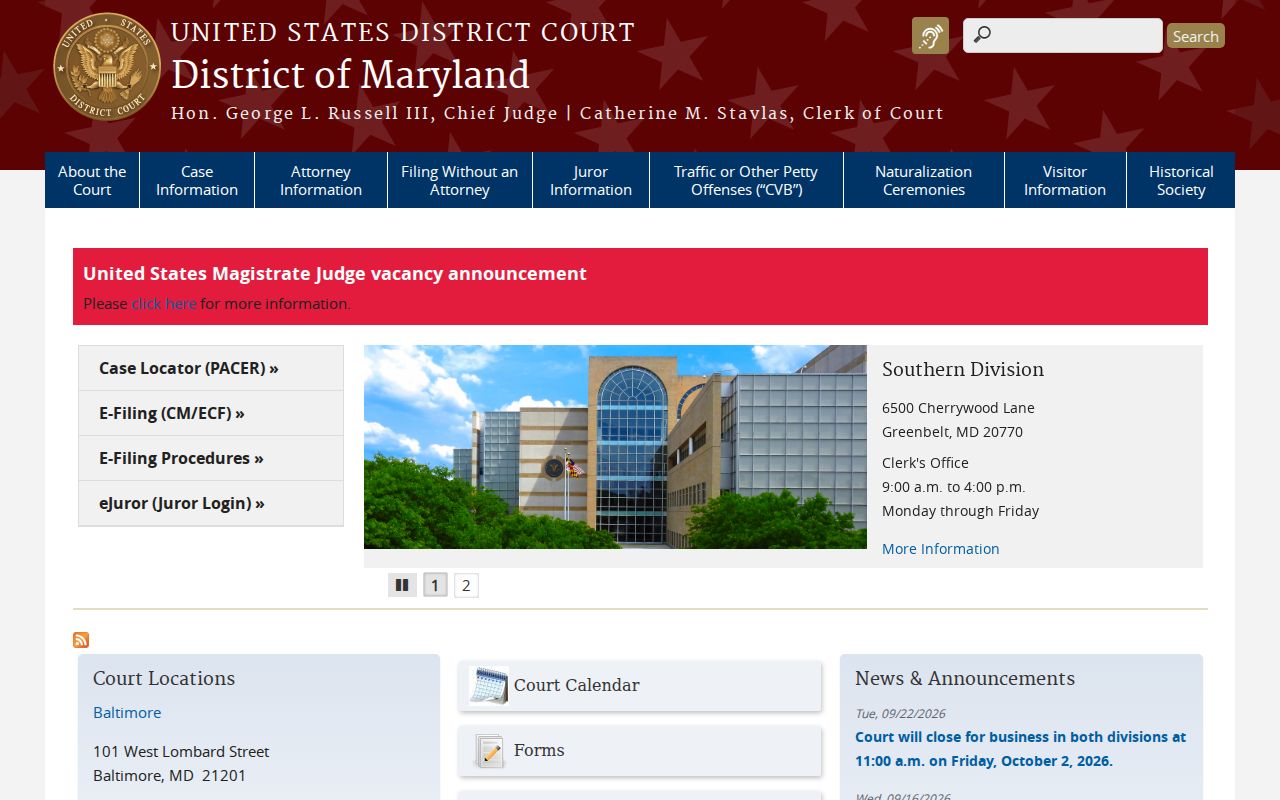
The homepage names the official federal venue and its case-information route for Maryland. It cannot substitute for counsel or reveal sealed warrant status.
U.S. Marshals Service District of Maryland
Federal warrant service and fugitive operations for the Maryland federal district.
Capital Area Regional Fugitive Task Force
Multiagency fugitive coordination across Maryland, D.C., and Virginia.
Maryland Warrant Data Stays in Restricted Systems
Names like METERS, NCIC, E*Justice, and LInX show up in law-enforcement material. None of them is a search site for residents. These are access-controlled channels, and no public source lists the participating agencies, warrant types, query fields, or refresh timing. Seeing one system named proves nothing about a particular warrant's entry or status across agencies. Maryland's DPSCS CJIS Central Repository plays a different role. It provides criminal-history record services and receives reportable events under state law. Event reporting is not public access to an active-warrant index. The CJIS Central Repository page describes those services, so treat it as background rather than a warrant lookup.
- Maryland State Warrant System
- A restricted agency query of District Court warrants described in a 2018 police directive; operator and wider coverage are unconfirmed.
- NCIC
- A restricted national law-enforcement information system, not a public name-search portal.
- CJIS Central Repository
- A criminal-history record repository with statutory event reporting, separate from public Case Search.
- Case Search
- A public court-case index that can help locate a docket but cannot certify current warrant status.
No Statewide Warrant Amnesty Was Identified in Maryland
Maryland has no statewide warrant-amnesty week, uniform roundup, or blanket clearance event. The Judiciary, MSP, MVA, and county materials publish none. A local event might be a surrender arrangement or an enforcement operation, and those are different things. No news report or burst of fugitive activity implies a deadline, fine waiver, or guaranteed release. What you can do depends on the issuing jurisdiction and the case. Ask the court whether a warrant is active and whether the next step is a motion, a hearing, an appearance, surrender, bond, or something else. A fine payment plan, where one is available for a qualifying matter, does not by itself recall the warrant. Use Browse Counties to reach the local court and sheriff route in Maryland.
Statewide Index vs Maryland County Warrants
An agency index and the local court file serve different users. Maryland's restricted State Warrant System lets an agency query District Court warrants, while each issuing court keeps its own case record. A county sheriff or another assigned agency may hold service or return details that a public docket never shows. There is no verified public statewide warrant index to serve as a final status check. For a state warrant, pick the likely county or Baltimore City and ask the issuing clerk to confirm the case. If staff points you to the sheriff or another serving agency, ask that office about execution or return information. The statewide and local channels do not swap. Nothing guarantees the two update at the same time either, so confirm with the Maryland office that holds the record before relying on either channel alone.
| Question | Restricted State Query | Local Court and Agency |
|---|---|---|
| Audience | Authorized agency query documented for District Court warrants. | Clerk manages the case; assigned agency handles service information. |
| Public route | No resident search interface verified. | Public docket or record request, subject to limits; direct status confirmation from the court. |
| Coverage known | Full operator, participation, and warrant-class scope are unknown. | Specific issuing court and case can be identified locally. |
| Next step | Not available for a resident self-check. | Use Browse Counties to reach the local clerk and sheriff route. |
Note: County routing identifies the local record holder; a sheriff there cannot confirm warrants issued in every other Maryland jurisdiction.
Maryland Warrant and MVA Notices Differ
Maryland drivers sometimes get two very different pieces of mail. One is a court matter. The other is a Motor Vehicle Administration notice. Transportation §16-204 lets the MVA suspend driving privileges after law enforcement reports an outstanding warrant. Transportation §13-406.1 works differently. It allows a registration or transfer restriction in a narrower situation, after at least 31 days and one unsuccessful attempt to serve the person who stayed out of reach. The two statutes carry separate triggers and separate notice paths, so read your own notice carefully. The MVA never issues or recalls a Maryland warrant. Under §16-204, the satisfaction notice must come from a court or a law-enforcement agency, and the registration route sends you back to the reporting agency. Call the issuing court about the warrant itself, then ask separately how the administrative record gets cleared. Neither statute builds one universal failure-to-appear portal.
| Transportation §16-204 | Driving-privilege suspension after qualifying law-enforcement notice; satisfaction notice comes from a court or agency. |
|---|---|
| Transportation §13-406.1 | Separate registration or transfer restriction with the 31-day and unsuccessful-service conditions; resolve through the reporting agency. |
| Public access | Neither mechanism is a public warrant-status search or a substitute for the issuing court. |
Read the official texts for §16-204 and §13-406.1 with the notice in hand.
Maryland Warrant Records Have Access Limits
Maryland General Provisions §4-316 keeps certain court files closed for a stretch. Some arrest warrant and charging document files stay restricted. They open once the warrant is served and the return is filed, or after 90 days pass. Exceptions and court orders can change that timing. Grand-jury or conspiracy warrant material can wait longer, until related warrants are served and returns filed. None of this hides every Maryland warrant record. Nor is a public case index complete. Maryland juvenile delinquency records are confidential under separate law and court rules. Seeing a court file means following judicial-record procedures. Executive agencies answer to separate public-information rules. Those rules cannot override a court restriction. When Case Search skips a document, ask the local clerk about access routes and limits. The exact categories and timing sit in General Provisions §4-316.
Access limit: A missing public document does not confirm whether a warrant exists; the court can explain whether a particular record is restricted and how to request it.
How Maryland Warrant Systems Went Digital
Maryland's digital warrant history is only partly documented. One dated window comes from a 2018 Montgomery County Police directive. It shows agencies querying District Court warrants through the Maryland State Warrant System on the day issued. Beyond that, details are thin. Maryland publishes no founding date for the system, no named operator, no technical design, and no statewide rollout milestones. No single-platform story fits, nor one complete county-to-state feed. On March 14, 2026, the Maryland Judiciary launched a redesigned Case Search & Record Portal. It integrates public Case Search and Judiciary Record Search. A January launch date had been delayed for data conversion. The redesign changed the public case-record interface. It did not change the documented scope of restricted warrant queries. Local courts still control recall. Check the portal's live fields directly, because its interface is JavaScript-driven. So Maryland now runs public docket access and restricted operational systems side by side. Required event reporting flows to the Central Repository. Agency query tools serve officers, while the Judiciary portal serves readers. A digital record in one Maryland channel does not establish that all other channels updated, or that a public way to search them exists.
Note: Maryland's March 2026 portal launch is an access milestone, not a new statewide warrant register.
Maryland Warrant Status Needs Local Confirmation
A docket entry that hints at a warrant is a lead, not an answer. Use the case number and call the issuing court. A Maryland District Court clerk handles traffic, misdemeanor, and other District Court cases. The Clerk of the Circuit Court covers that court's criminal files. Ask three things. Is the order still active, what does the judge require, and which agency holds service or return information? When the filing jurisdiction is unclear, search the Judiciary portal for a public case, then route by court and county. A blank result is not clearance. Contact the likely local court instead. Maryland's courts sit in 23 counties plus Baltimore City, and the Browse Counties directory reaches them all. Federal matters are different; they run through the U.S. District Court and the U.S. Marshals.
- Identify the likely court from the case or citation and keep the case number and dates nearby.
- Ask the clerk to confirm warrant status and explain whether a hearing, motion, appearance, or other court action is required.
- Ask which sheriff or agency handles execution and whether a separate MVA notice or satisfaction update is involved.
Note: In Maryland, the court that issued the warrant still controls the local case record and the next judicial step.